Station 9 – The Goll Main Organ
Listen to audio
Behind the Scenes of the Main Organ
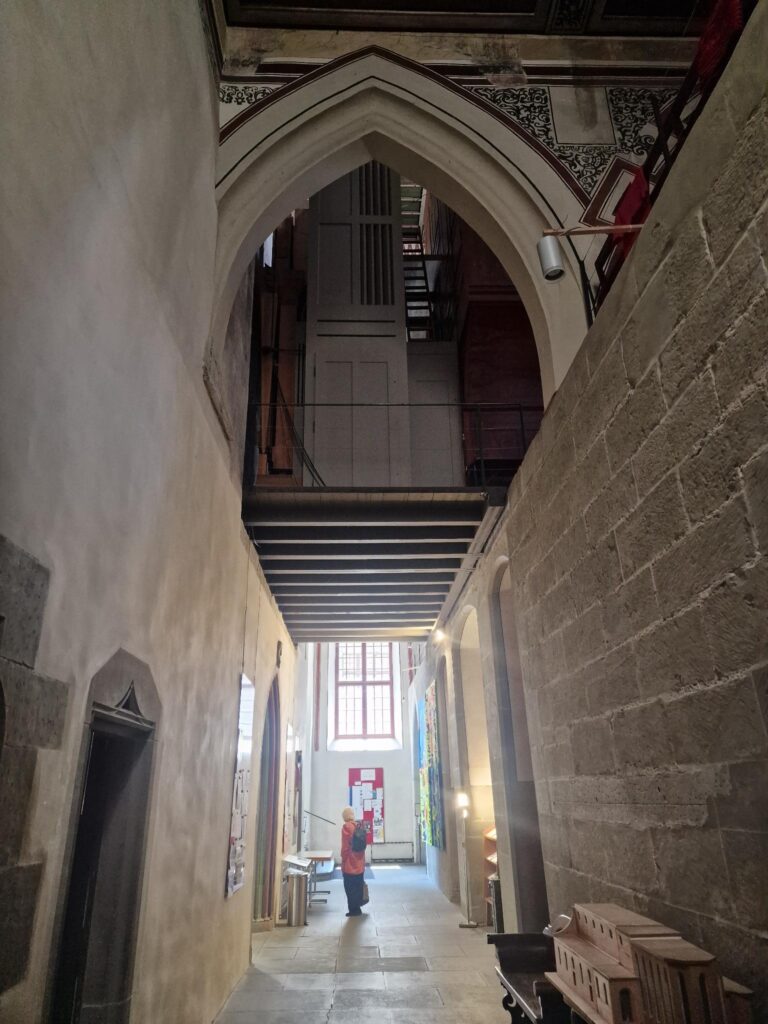
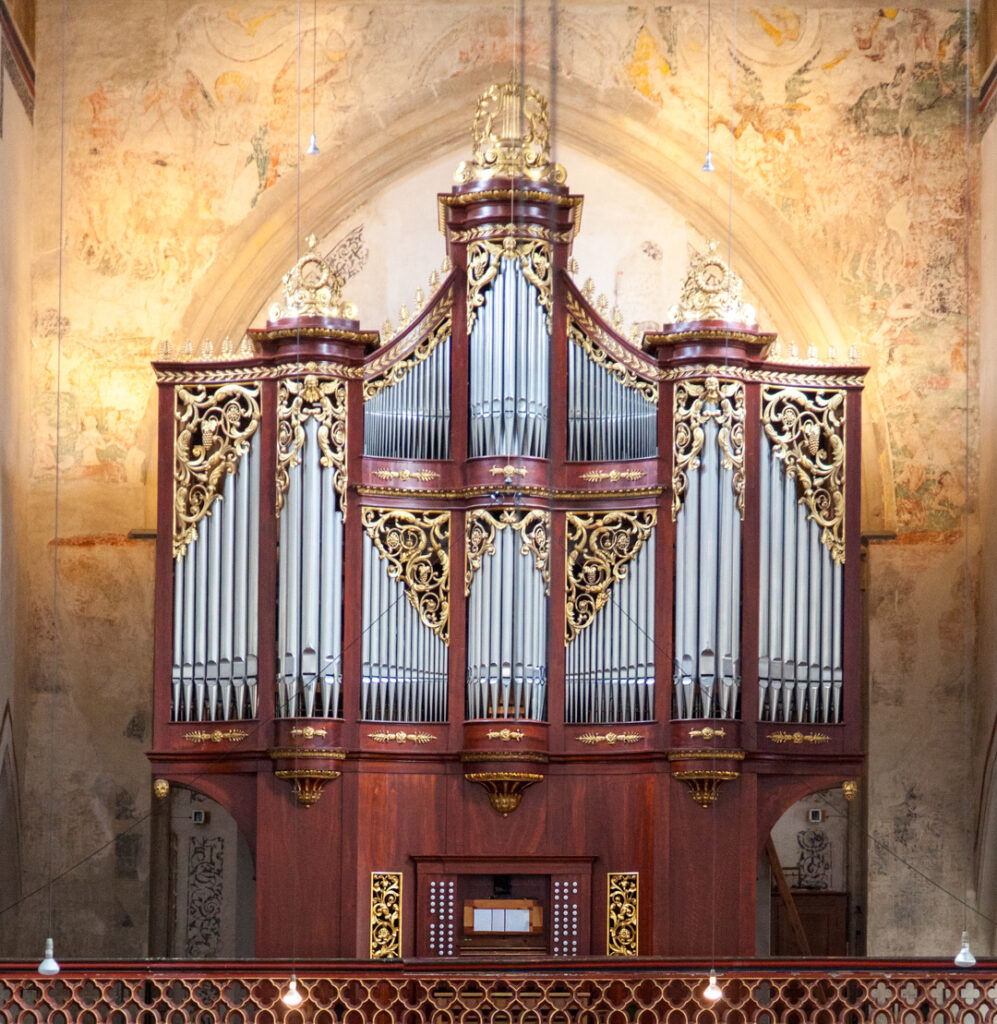
The second organ built after the organ ban, dating from 1756, is present in important parts of the current instrument. This organ from 1991 by the Goll company from Lucerne is considered, due to the diversity and beauty of its sound combinations, the “Rolls Royce” among Bern’s city organs.
The Main Organ
Also listen
MODEST MOUSSORGSKI – Excerpts from: Pictures at an Exhibition (1874)
Loïc Bürki, Goll organ, Estival 7, 16 September 2023.
MAX REGER - Basso ostinato, op. 129 Nr. 6 (1913)
Julia Aebi Shandaraeva, Goll Organ, Estivales, 13 July 2024
SIGFRID KARG-ELERT – The sun’s evensong (1923)
Babette Mondry, Goll Organ, Estivales, August 5th 2023.
MEL BONIS – Idylle op. 179 (1935)
Antonio García, Goll Organ, Church Service, August 6th 2023.
LOUIS JAMES ALFRED LEFÈBURE-WÉLY: Sortie en sol mineur (1865)
Antonio García, organ, Musical Tour, September 17th 2023
JÖRG HERCHET – Excerpt from Composition 3, 'Namen Gottes, XV‘ (2000)
Samuel Cosandey, Goll organ, Estivales, 19 August 2023
Organs in the French Church of Bern
Before the Reformation, there are two organs in the former Dominican Church of Bern: a swallow’s nest organ (above the first north-eastern pillar of the nave) and an organ in the choir. As part of the Reformation-related transformation, the nave and choir are separated from each other by a wall. On the free-standing Gothic rood screen, which has fortunately been preserved, one of the most fascinating post-Reformation organ histories in the city of Bern has unfolded.
1728 The organ by Joachim Rychener is inaugurated in 1728 as the first major church organ on Bernese soil after the lifting of the Reformation organ ban (by the Council decree of 1726). This instrument probably has 20 stops on one manual and pedal. Shortly thereafter, devastating judgments about this organ lead to considerations of a new construction. The instrument is donated to the city church of Aarau, where Johann Conrad Speisegger uses parts of it for his new organ. However, the case is newly built by Speisegger, which is why we unfortunately have no reference points for the organ façade of the Rychener organ to this day.
1756 Victor Ferdinand Bossart (son of Joseph Bossart, the founder of the significant organ-building dynasty from Baar) builds the new organ, again with only one manual and pedal, probably with 16 stops. Hans Gugger, the experienced Bernese organ researcher, suspects a traditional five-part organ façade with two flanking round towers framing a low central tower and two concave inward-curving intermediate fields. This corresponds to the five central fields of the current façade front (without upper work and without outer pedal fields).
1828 Franz Joseph Remigius Bossart (grandson of Victor Ferdinand) receives the commission in 1828 for the “completion” of the organ. The keyboard range is to be extended by 5 notes from C–c3 to C–f3. A second manual division is added and the entire organ is reworked. The Hauptwerk now has 10 stops, the Oberwerk 8, and the pedal 4 stops, totaling 22 stops. The façade receives its present appearance through the addition of the Oberwerk and the additional pedal side fields, which was restored during the organ rebuild by Orgelbau Goll Lucerne in 1991.
1915 Orgelbau Goll Lucerne receives the commission to build a new 3-manual organ with 49 stops into the existing case, which is extended laterally with grilles for this purpose. 1932 Orgelbau Kuhn Männedorf builds a new instrument with 57 stops, whereby Goll’s choir organ from 1913 is integrated as the 4th manual (Fernwerk). Inauguration.
1962 The main organ is rebuilt and expanded by Orgelbau Goll Lucerne to four manuals with 66 stops. In the upper floor of the choir space, subdivided with a concrete ceiling, a new 2-manual organ with 18 stops is built (Orgelbau Goll Lucerne). During the restoration measures of 1988-91, the intermediate ceiling in the choir was removed again and the choir organ from 1962 was relocated to the Jura to Moutier (German Reformed Church).
1991 As part of the fundamental restoration of the church in 1988-91, the instrument is newly built by Orgelbau Goll Lucerne using the Bossart case elements from 1756 and 1828. In advance, there are considerations to remove the partition wall between nave and choir and to relocate the organ to a newly constructed west gallery, in order to restore the original spatial impression of the free-standing rood screen with a view through to the choir. However, the heritage conservation authority decides to preserve the partition wall, so that the new instrument retains its original location on the rood screen. The disposition with 66 stops by titular Prof. Philippe Laubscher combines classical French elements with romantic-symphonic ones. The instrument is built with purely mechanical action (including all couplers) and represents, as the first four-manual organ in the era of Jakob Schmidt / Beat Grenacher, a milestone in the recent history of the Goll company. Meanwhile, in the Lucerne workshop, in addition to many small and medium-sized new construction projects, 17 three-manual and 3 four-manual instruments have been built. The stop action is additionally equipped with electromagnets for control via setter (double registration).
2010 A new setter system (Eisenschmid) is installed with expanded memory capabilities (USB stick). 2012 The first cleaning/revision of the instrument takes place with the installation of the stop Septième 11/7′ (instead of Neuvième 8/9′).
Audio finished
What would you like to do next?